





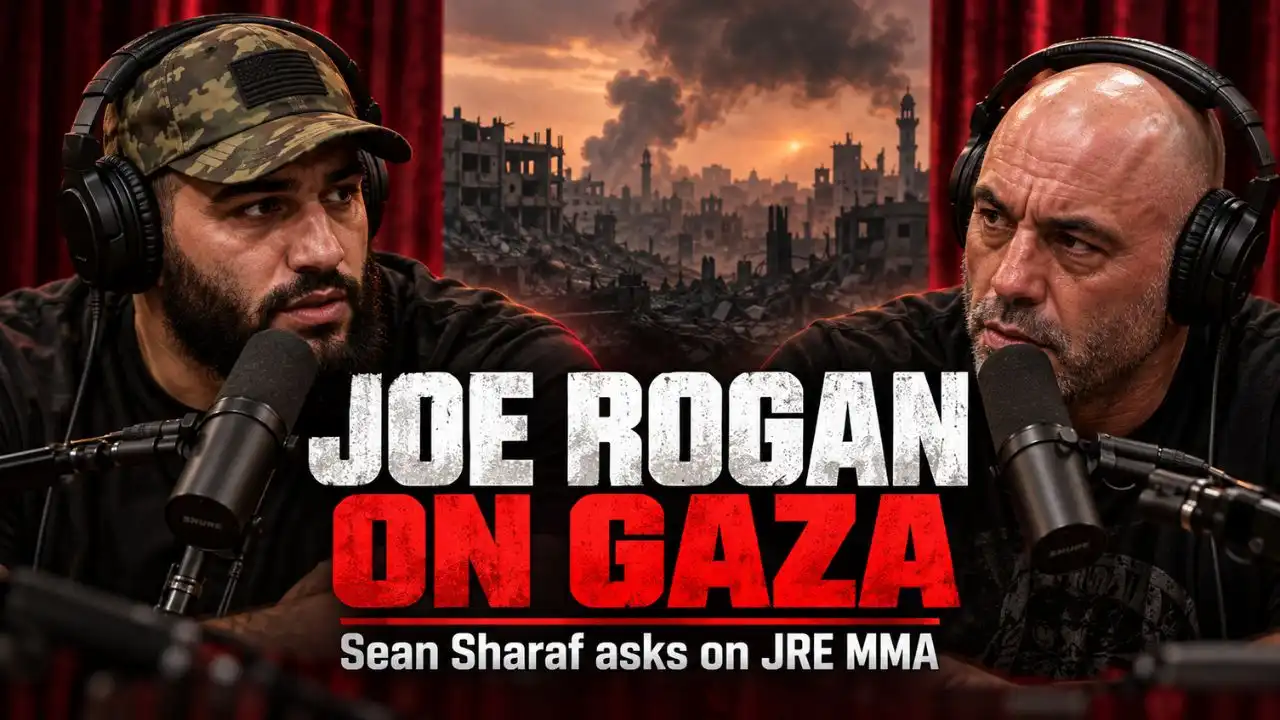
Sean Sharaf Asks Joe Rogan About Gaza on the JRE MMA Show

Sean Sharaf asked Joe Rogan how he felt about what Sharaf called a genocide, and Rogan answered without hedging. The exchange comes from JRE MMA Show #186, released October 1, the day after Sharaf sat down with Rogan in the wake of the biggest win of his UFC career.
Sharaf, wearing a camouflage cap and headphones against the red curtain, opened the subject by asking whether they were allowed to talk about it. Rogan told him he could talk about anything he wanted. Sharaf then put the question directly. “How do you feel about the genocide there that’s going on with all the, like, the women and children?” he asked.
Rogan said he had already been public about his view. “Well, I’ve been very open about it,” Rogan said.
“I think it’s horrific. I think it’s terrifying that people will dismiss it.” He called it “a horrific injustice against humanity” and asked how many thousands and tens of thousands of women and children had been destroyed by missiles from the sky.
The heavyweight did not answer with his own account in the clip. Rogan kept going, asking how many buildings were gone and saying, “Like, only like 90% of Gaza is gone?” Those figures are Rogan’s wording in the interview, not a finding presented on the show. He said there was no way to look at it and not call it a horrific incident. “It’s a horror,” Rogan said.
He then pointed to video from the territory. “It’s one of the most, you look at the video footage of Gaza, it’s f***ing terrifying,” Rogan said. “There’s humans that are just under that rubble that they’re never going to find.” The clip ends on that line, with Rogan still talking and Sharaf off camera.
The episode itself is built around Sharaf’s fighting life, not a standalone foreign-policy interview. PowerfulJRE lists him as a UFC heavyweight, and the published show runs more than two hours. The Gaza exchange is one stretch inside that conversation. Sharaf has spoken about Palestine on other platforms, including a September appearance on Bradley Martyn’s Raw Talk, so the question on Rogan’s show was not his first public comment on the subject.
The timing still puts the remark next to a result that changed his standing in the promotion. Sharaf entered UFC 331 on September 19 at Crypto.com Arena with an 0-2 UFC record, both losses by knockout. DraftKings had Gable Steveson near -2400 and Sharaf at +1200. Sharaf knocked Steveson out in 12 seconds, a result Covers described as the biggest outright UFC underdog win in DraftKings history.
That upset is why he was on the podcast. Rogan spent the early part of the episode asking when the Steveson offer arrived and how a Marine who had been trying to get on the Los Angeles card ended up in the biggest spot of his career. The Gaza question arrives later, after Sharaf checks whether the subject is allowed and Rogan tells him the microphone is open.
Rogan’s answer does not name a government, a date, or a legal finding. He describes footage he says he has watched, calls dismissal of it terrifying, and treats the scale of the destruction as obvious.
Sharaf supplies the word genocide in the question and does not add a longer statement in the portion that has circulated. Listeners are left with Rogan’s description and Sharaf’s decision to raise it on a show that was otherwise about a 12-second knockout.
Sharaf is now 5-2 and no longer an anonymous heavyweight who lost his first two UFC fights. The same week that produced the Rogan booking also produced his public comments about debt, a brain scan, and whether the Steveson win was the moment to leave. The Gaza exchange adds a different kind of attention to a fighter the promotion has only just been forced to notice.

